

ODI World Cup 2027: Dates, Venues, Format & Teams
ODI World Cup 2027: Dates, Venues, Format & Teams. Imagine a World Cup opening under the African sky, with cricket played beside one of the world’s great waterfalls. That picture is now a real plan. After a long wait, the sport’s biggest 50-over tournament is heading back to Africa, and this time it comes with a new look, a bigger field and a format built to keep the drama alive.
The Basics: Dates, Hosts and Theme
Cricket’s biggest 50-over event returns in autumn 2027, with the action beginning on 4 October and the final due on 21 November. Three southern African nations, South Africa, Zimbabwe and Namibia, will share hosting duties. The competition will be the fourteenth World Cup in the sport’s history.
indiacricketschedule
It is also a homecoming. The World Cup returns to Africa for the first time in 24 years, after South Africa, Zimbabwe and Kenya jointly hosted the 2003 edition. Namibia will be a first-time host, which makes the event a milestone for associate cricket too.
geo
The tournament carries the theme “Three Nations, One Heartbeat”, which celebrates the shared optimism, diversity and unity of the three hosts. For a competition spread across thousands of kilometres, that message fits well. Cricket fans in all three countries will get to feel part of the same story.
Twelve Venues, Three Countries
The ICC has confirmed twelve venues: eight cities in South Africa, three in Zimbabwe, and Windhoek in Namibia.
In Zimbabwe, the matches will go to Harare Sports Club, Queens Sports Club in Bulawayo and the Mosi-oa-Tunya International Cricket Stadium in Victoria Falls. Namibia’s games will be played at the Namibia Cricket Ground in Windhoek.
South Africa will stage most of the action. The list includes famous grounds such as Newlands in Cape Town and Kingsmead in Durban. Buffalo Park in KuGompo City, the new name for East London, is also on the list.
The mix is interesting. Big city stadiums bring large crowds and loud atmospheres. Smaller venues bring charm and a chance for new fans to see world-class cricket up close. Victoria Falls, in particular, is sure to become one of the most photographed grounds of the event.
Fourteen Teams After Two Smaller World Cups
The last two World Cups had just ten teams. The 2027 edition grows to 14 teams. That is good news for smaller cricket nations, who have often had to watch from outside.
South Africa and Zimbabwe qualify automatically as hosts. They are joined by the top eight teams in the ICC ODI rankings as of 30 September 2026.
On the current rankings, Afghanistan, Australia, India, New Zealand, Pakistan, Sri Lanka, England and Bangladesh are on course for the eight direct spots. Since that cut-off date is today, fans should check the ICC’s official confirmation of the final list.
The remaining places will be decided in a separate event. The World Cup Qualifier is scheduled for 22 February to 23 March 2027. Four teams will come out of that route.

A New Format With Extra Twists
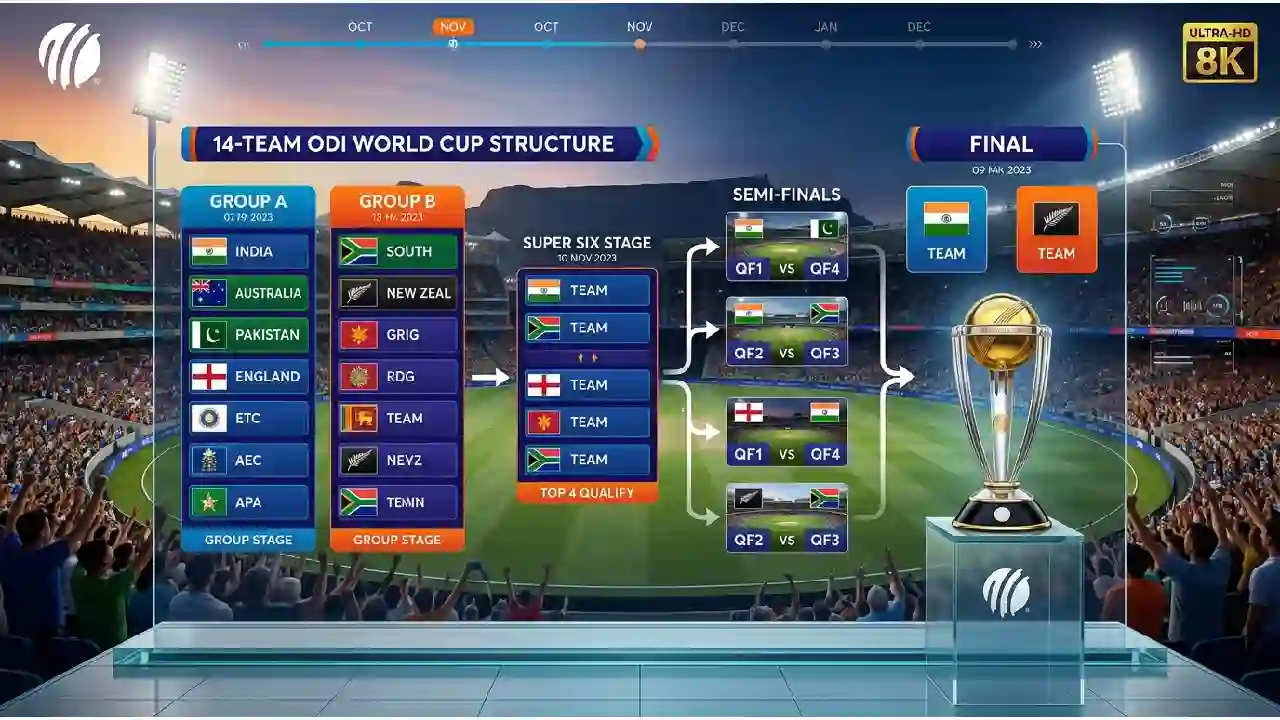
This is where the 2027 World Cup really changes things. The ICC has moved away from the old Super Six idea and built a three-stage structure before the knockouts.
Stage one: the Super Series. The three lowest-ranked qualified teams play each other in a round-robin Super Series. Only one of them moves on. It is a tough opening test, and every ball will matter.
olympics
Stage two: the group phase. Twelve teams are split into two groups of six. The top three from each group, plus the best fourth-placed side across both groups, reach the Super 7 stage. That extra place means even a team that struggles early has a thin lifeline.
olympics
Stage three: the Super 7. The seven qualifiers play each other once in a round-robin, and the top four go through to the semi-finals. After that come the two semi-finals and the final.
olympics
The design rewards consistency. It also guarantees many high-quality matches before the knockouts. On the other hand, a longer event will test depth, fitness and squad rotation.

Who Are the Teams to Watch?
History gives one clear guide. Australia has been the most dominant side in World Cup history, while India and West Indies have each won the title twice. Australia also won the most recent edition in 2023, which makes them the reigning champions.
olympics
India will arrive as one of the strongest squads on paper. Their deep batting and quality spin options suit many conditions. Even so, African pitches can offer more bounce and pace than the subcontinent does, so adaptability will be important.
South Africa will carry the hopes of a home crowd. The country has produced some of the game’s best fast bowlers, and home conditions should suit them. The pressure will be heavy, though. South Africa has long been a dangerous World Cup team without lifting the trophy, and the home tournament gives them a real chance to change that story.
England, New Zealand and Pakistan are all capable of beating anyone on their day. Afghanistan and Bangladesh will also fancy their chances of causing upsets, especially in the new Super Series and group phases.
Conditions That Could Shape the Tournament
Hosting across three countries means a wide range of conditions. Coastal grounds like Durban and Cape Town often help seam and swing bowling, particularly early on. Higher-altitude venues tend to favour stroke-makers, with quick outfields and true bounce.
Zimbabwe and Namibia may offer their own surprises. Pitches there can be slower and may assist spinners as matches go on. Teams that can read the surface quickly and adjust their plans will have an edge.
The October–November window is also worth noting. It covers late spring into early summer in southern Africa, which usually brings warm, pleasant days. Fans should still expect some weather risk at certain venues. Rain interruptions can change plans and tactics, especially in a format where qualification may come down to fine margins.
Why This World Cup Matters
This is more than a scheduling story. A World Cup in Africa can grow the game in a region where cricket is still expanding. Namibia’s role as a host is a good example. For young players there, watching the world’s best in their own capital could be a life-changing experience.
The larger field matters too. More teams mean more chances for emerging nations to test themselves against giants. Over time, that helps raise standards everywhere.
The format also keeps the stakes high. With a Super Series at the start and a Super 7 in the middle, there is little room to coast. Every team will need a clear plan from day one.
Fixtures: What Is Confirmed and What Is Not
Several fan websites have published fixture lists with specific dates and opponents. Those lists look unofficial and do not agree with each other, so I have left them out of this article. Treat them with caution until the ICC releases the complete official schedule.
Here is what is solid so far:
The dates are 4 October to 21 November 2027.
The hosts are South Africa, Zimbabwe and Namibia.
The field is 14 teams.
The format is Super Series, two groups of six, Super 7, then semi-finals and the final.
Anything beyond that, such as the opening match, the final venue or the exact group draw, should be checked on the ICC’s official website when it is announced.
What Happens Next
The next big moments are the World Cup Qualifier in early 2027 and the official fixture and group announcements. Those will set the real story in motion: who meets whom, where the marquee clashes will be played, and which teams get favourable early matches.
Squad selections will follow closer to the event. Until then, bilateral series and rankings will keep shifting the picture. Form, injuries and captaincy changes could all reshape who the favourites are.
Final Word
The 2027 ODI World Cup has the ingredients of a memorable event. It has a fresh format, a larger field, three host nations and a return to African soil after more than two decades. It also has reigning champions with a target on their backs and a home team desperate to break a long wait
The story will only be written once the matches begin on 4 October 2027. When it does, this preview will need an update with real moments, real heroes and a real champion. For now, the build-up alone is reason enough for cricket fans to start counting down.