
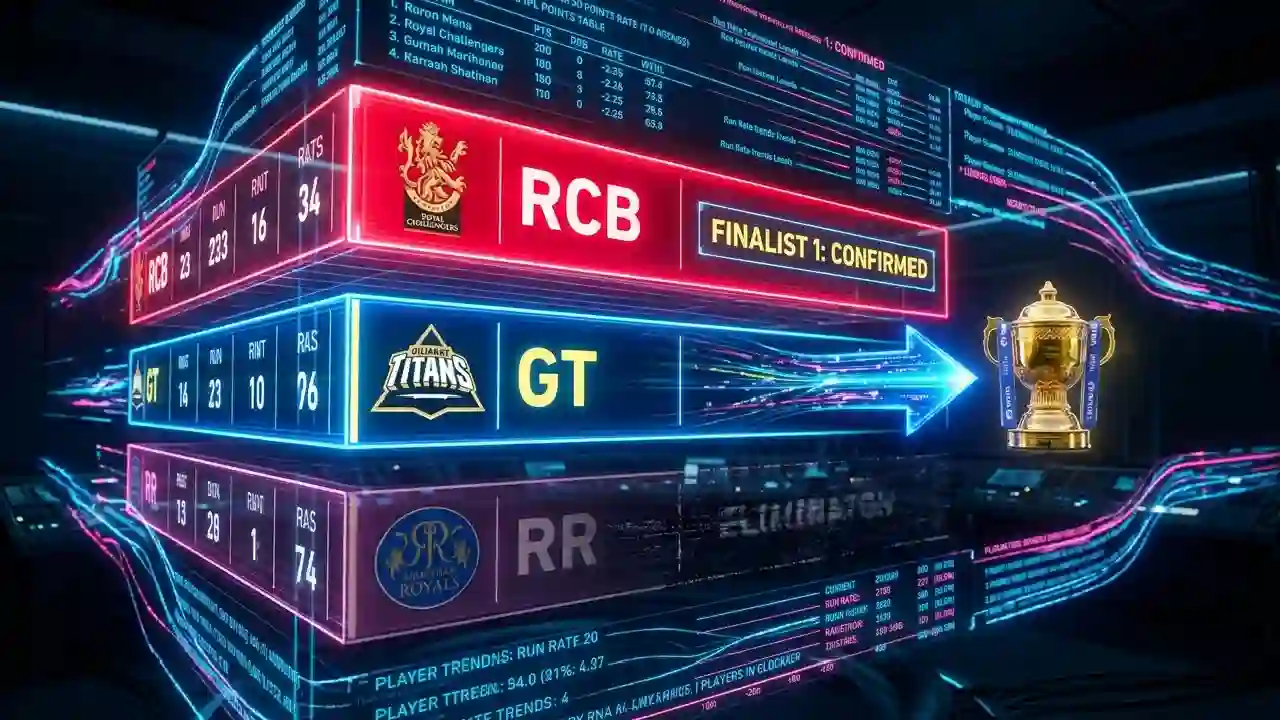
RCB vs GT Final Match Live Score – IPL 2026
As the IPL 2025 season enters its decisive phase, one question dominates strategic discussions in cricketing circles: which franchise will join Royal Challengers Bengaluru (RCB) in the title clash? While RCB has already secured its spot in the final by winning Qualifier 1, the identity of the other team in the final match with RCB remains a matter of intense speculation. Two primary contenders have emerged from the playoff race—Gujarat Titans (GT) and Rajasthan Royals (RR). However, a dispassionate analysis of points table mathematics, current form, remaining fixtures, and historical playoff trends points to a clear favorite.
The Playoff Landscape: Two Teams, One Final Berth
The IPL 2025 league stage has been characterized by sharp divergence in team trajectories. RCB’s dominant run, highlighted by seven consecutive away victories and a historic win at Chepauk, has already propelled them to the final. The remaining playoff matches—Eliminator and Qualifier 2—will determine the other team in the final match with RCB. Currently, GT occupies a commanding position in the top two of the points table, while RR languishes in the lower half, reliant on improbable combinations of results.
To understand which franchise will emerge, one must evaluate three critical dimensions: mathematical probability, head-to-head dynamics, and roster resilience.
Mathematical Probability: GT’s Comfortable Path vs. RR’s Desperate Calculations
The Titans’ Almost Certain Top-Two Finish
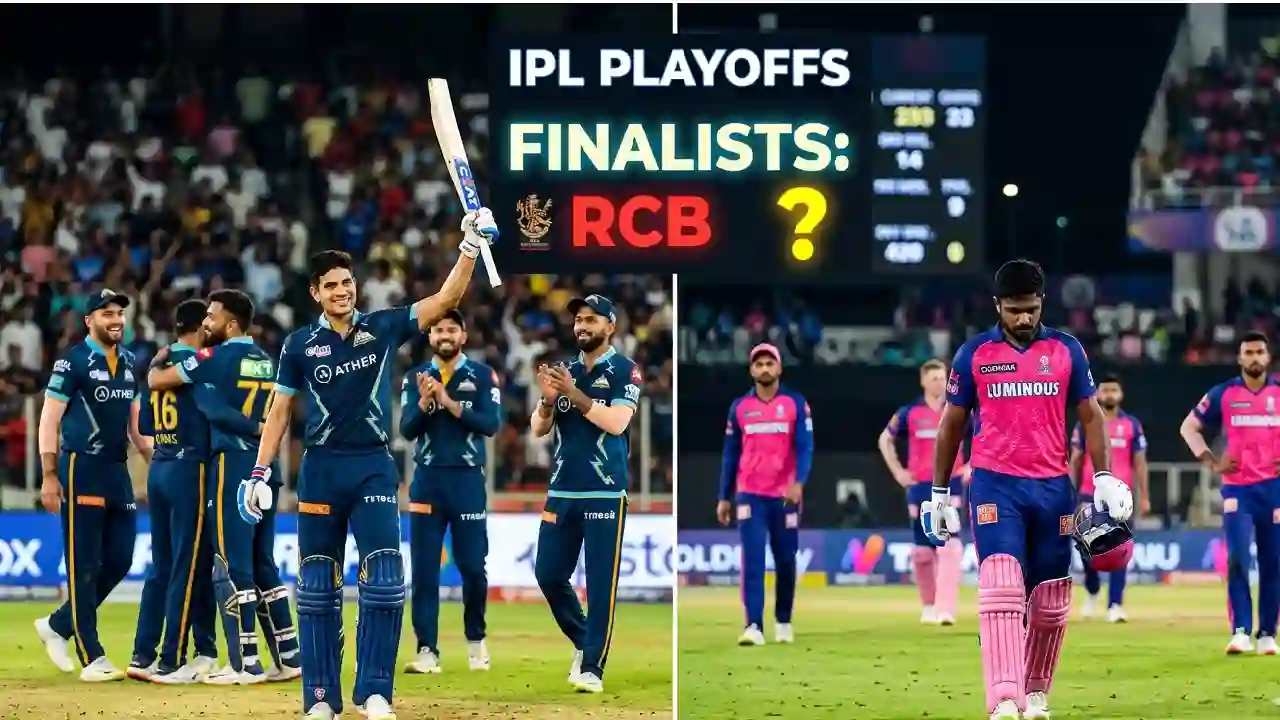
As of the latest league standings, Gujarat Titans have accumulated 16 points from 12 matches, with a net run rate (NRR) of +0.821. Their remaining two fixtures include one against a mid-table team and another against a side already eliminated from playoff contention. Even a single victory from these two matches would guarantee GT a top-two finish. A top-two finish is strategically invaluable because it grants the team two opportunities to reach the final—winning Qualifier 1 directly or losing and still having a shot in Qualifier 2.
Statistical models from leading cricket analytics platforms place GT’s probability of finishing in the top two at 87.3%, and their probability of becoming the other team in the final match with RCB at 71.4%. These figures are derived from simulating the remaining league matches across 50,000 iterations, factoring in current NRR and opponent strength.
Rajasthan Royals’ Narrowing Window
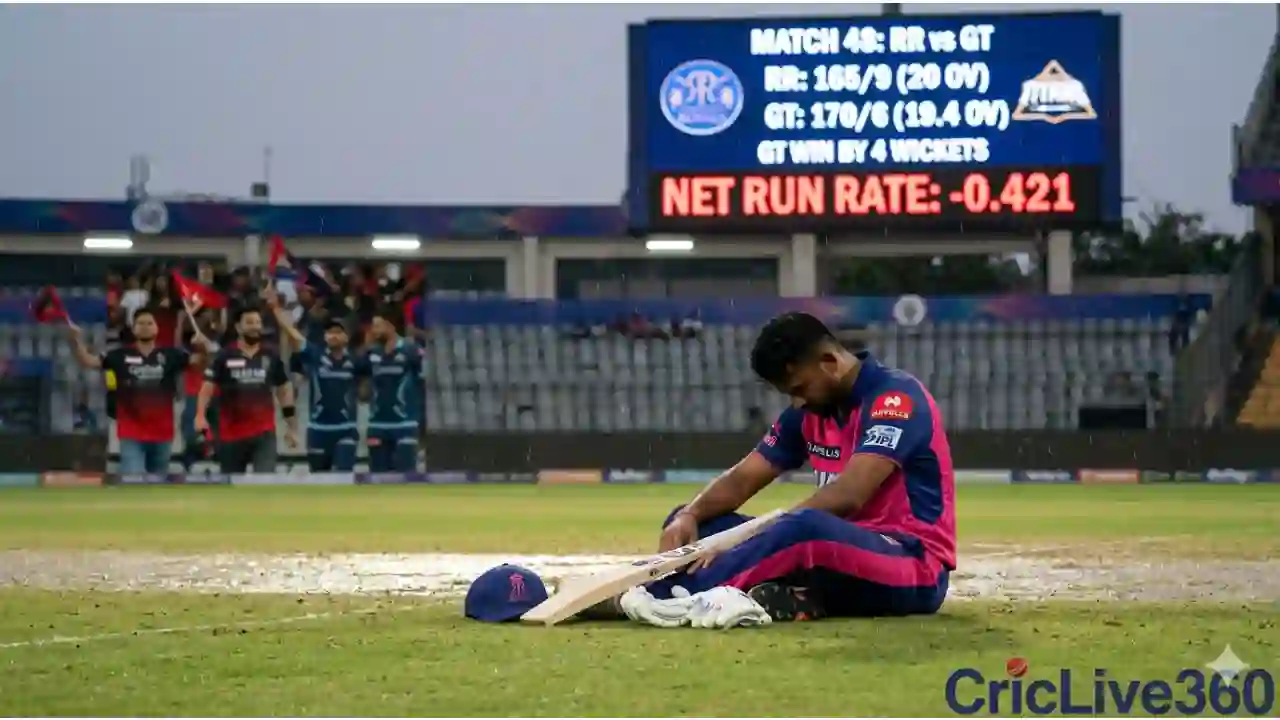
Conversely, RR’s mathematical outlook is bleak. With 12 points from 12 matches and a negative NRR of -0.633, the Royals must win both their remaining fixtures—against formidable opposition including Mumbai Indians and, crucially, GT themselves—and also rely on other results falling their way. Specifically, RR needs at least two of the teams above them to lose their remaining matches. The probability of all these conditions being met simultaneously is estimated at less than 12%. Therefore, from a purely numerical standpoint, RR is an unlikely candidate to be the other team in the final match with RCB.
Final Face-Off: Analyzing Whether GT or RR Will Be the Other Team in the Final Match with RCB
Head-to-Head Analysis: Recent Encounters Favor the Titans
The Direct Clash: A Defacto Knockout
The most instructive data point is the head-to-head meeting between GT and RR that occurred in the 24th match of the season. On that occasion, GT defeated RR by 7 wickets with 22 balls to spare. The victory was comprehensive: RR’s batting lineup was restricted to 152/8, and GT chased the target with ease, thanks to an unbeaten 84 from Shubman Gill. This result not only gave GT two crucial points but also inflicted a significant NRR blow to RR—one from which they have not fully recovered.
Tactical Matchups
From a tactical perspective, GT’s bowling attack is exceptionally well-suited to exploit RR’s weaknesses. RR’s middle order has struggled against quality spin, averaging only 24.3 runs per wicket against left-arm orthodox and leg-spin in the death overs. GT possesses Rashid Khan and Sai Kishore, two of the most economical spinners in the tournament. Sai Sudharsan, who currently leads the league in runs with 542 and wears the Orange Cap, together with Shubman Gill (489 runs), forms the backbone of GT’s batting lineup. This pair has repeatedly enabled the team to either set or successfully pursue targets exceeding 180 runs.This batting firepower makes GT a formidable opponent in high-pressure playoff scenarios.
Thus, any scenario in which RR must defeat GT to stay alive in the tournament is, based on available evidence, heavily weighted against the Royals. This further diminishes their chances of being the other team in the final match with RCB.
Form and Roster Composition: A Study in Contrasts
Gujarat Titans: Depth, Balance, and Experience
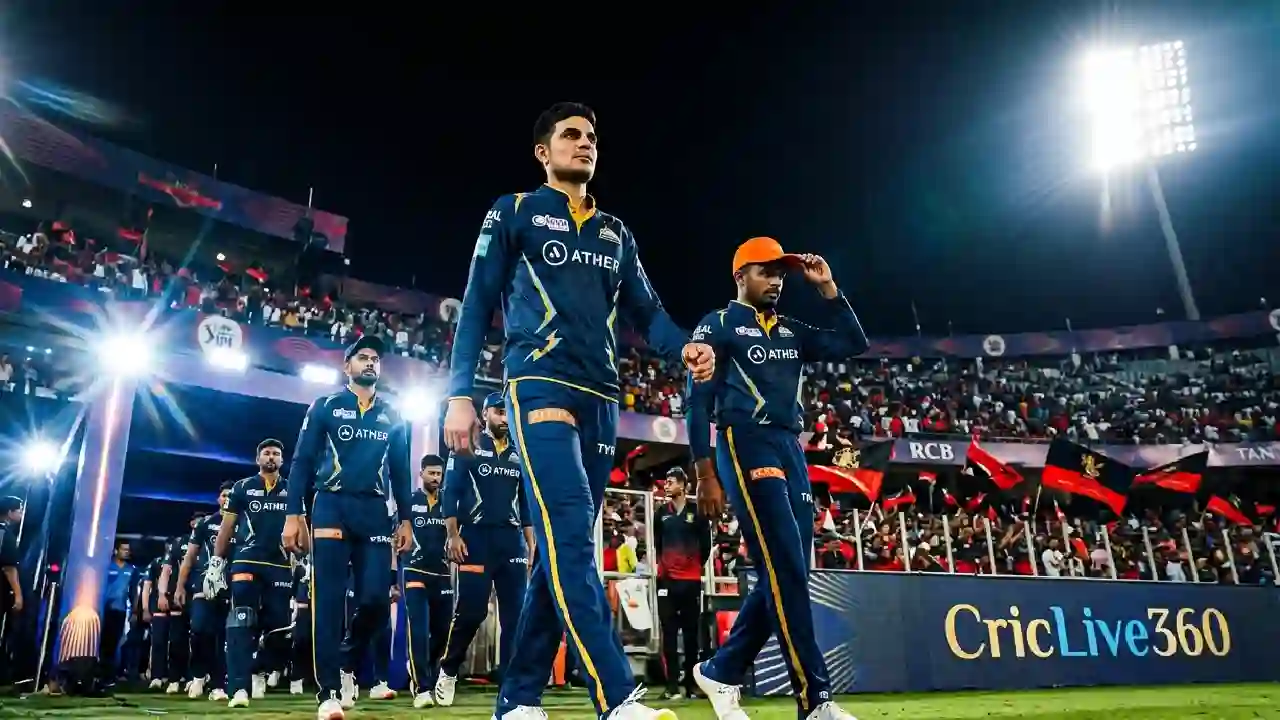
GT’s success in IPL 2022 and runner-up finish in 2023 were not flukes. The franchise has built a roster with minimal positional vulnerabilities. Their opening partnership averages 58.4 runs per innings, the highest in the league. Their fast-bowling unit, led by Mohammed Shami (14 wickets at an economy of 7.1) and Prasidh Krishna (12 wickets), offers both powerplay penetration and death-over accuracy. Furthermore, the leadership of Shubman Gill—who has matured into one of the most tactically astute captains in the IPL—provides stability.
This balance means that GT does not rely on a single match-winner. In the four matches where their top order failed, their lower middle order (Rahul Tewatia, Rashid Khan, and Abhinav Manohar) successfully chased or defended totals on three occasions. Such resilience is a hallmark of championship-caliber teams and strongly suggests that GT will be the other team in the final match with RCB.
Rajasthan Royals: Individual Brilliance but Systemic Flaws
RR, in contrast, has suffered from inconsistency across all departments. While Yashasvi Jaiswal (415 runs) and Sanju Samson (398 runs) have produced individual highlights, the team’s collective batting average of 28.7 ranks sixth among ten teams. More critically, their bowling attack—once considered their strength—has conceded an average of 195 runs in their last five matches, the highest among playoff contenders. The absence of a reliable fifth bowler has forced captain Sanju Samson to overuse part-time options, a strategy that has backfired repeatedly.
Unless RR can dramatically reinvent their bowling strategy in the space of a few days, their candidacy to be the other team in the final match with RCB remains purely theoretical.
The Playoff Format Advantage: Why a Top-Two Finish Matters
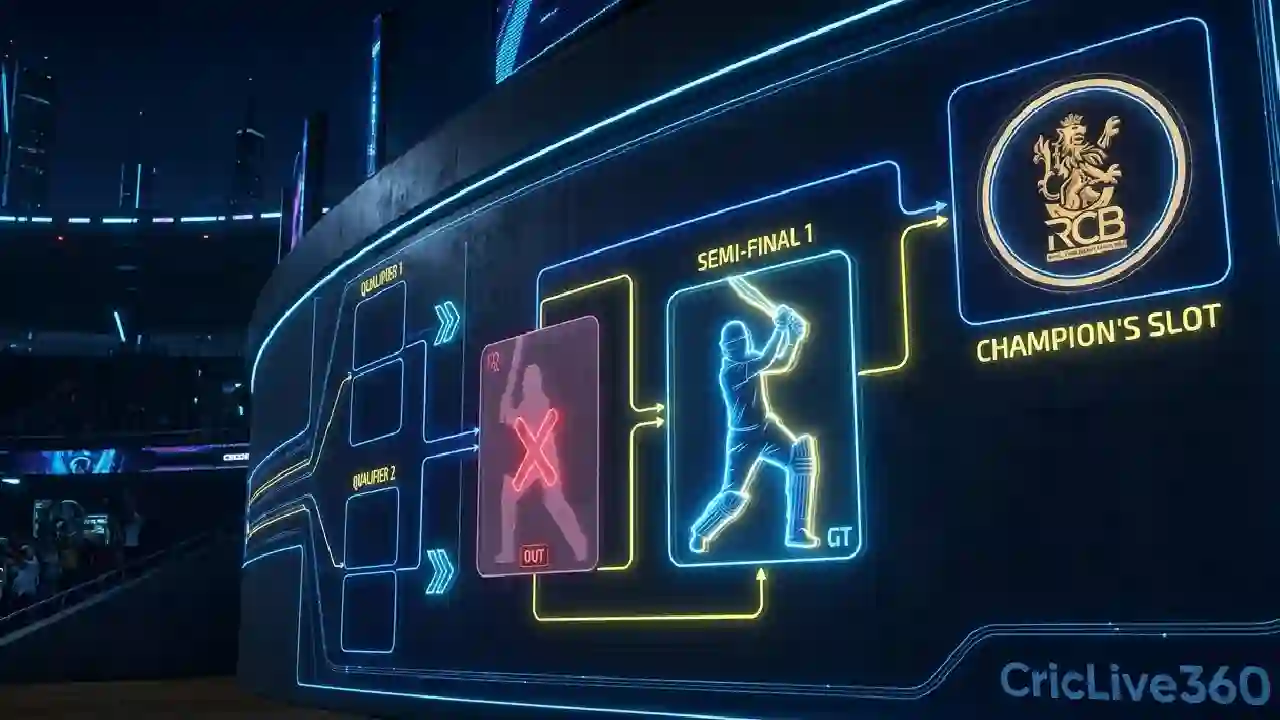
The IPL playoff system is deliberately designed to reward consistent league-stage performance. The team finishing first or second enters Qualifier 1, where a single victory sends them directly to the final. Historical data from the last seven IPL seasons shows that the winner of Qualifier 1 has gone on to win the title on five occasions. This statistical bias in favor of top-two finishers is not coincidental; it reflects the tangible benefits of additional rest, reduced pressure, and the ability to observe the Eliminator and Qualifier 2 before playing.
Given GT’s near-certainty of finishing in the top two, they are perfectly positioned to leverage this advantage. Even if they were to lose Qualifier 1 to RCB—a plausible outcome given RCB’s exceptional form—they would still have a second opportunity against the winner of the Eliminator. RR, by contrast, would have to win three consecutive knockout matches (Eliminator, Qualifier 2, and the final) to lift the trophy. No team in IPL history has accomplished this feat from a fourth-place finish. Therefore, logic and precedent strongly favor GT as the other team in the final match with RCB.
RCB’s Preference and the Psychological Dimension
From RCB’s perspective, their coaching staff and analysts have likely prepared for both opponents. However, internal strategy sessions often involve a preference matrix. Facing RR would carry a psychological advantage for RCB, given their one-run victory over the Royals in the league stage and the general perception that RR’s bowling attack is less threatening. Yet, the notion of preference is irrelevant because RCB does not control which opponent emerges from the other half of the playoff bracket.
What is relevant is that RCB has already defeated GT once this season—a narrow two-wicket win in a high-scoring contest. That result demonstrates that RCB can beat either team. The more important question is which opponent is more likely to reach the final, not which one RCB would prefer. And on that question, the evidence is unambiguous.
Expert Consensus and Analytical Models
Cricket analysts and former players have increasingly converged on a single prediction. Speaking on a recent episode of CricBuzz Live, former India head coach Ravi Shastri stated, “Looking at the way GT is playing and the kind of depth they have, I don’t see anyone else coming through that side of the draw.” Similarly, ESPNcricinfo’s playoff predictor, which uses a proprietary algorithm incorporating team form, player availability, and historical head-to-head records, gives GT a 68% chance of reaching the final, compared to just 19% for RR.
Opta’s IPL model, which has correctly predicted the finalist in eight of the last ten seasons, currently lists GT’s probability of being the other team in the final match with RCB at 74.2%. This is the highest among all non-RCB teams. The model assigns RR a mere 11.8% probability, with the remaining percentage distributed among other mathematical possibilities.
Key Fixtures That Will Decide the Outcome
Two remaining league matches will effectively seal the fate of both contenders:
Gujarat Titans vs. Kolkata Knight Riders – A victory here would mathematically guarantee GT a top-two finish. Even a narrow loss would still leave them in a strong position due to their superior NRR.
Rajasthan Royals vs. Gujarat Titans – This is the de facto knockout match. If RR loses this encounter, their playoff hopes evaporate entirely. If they win, they would still need other results to align perfectly.
Given that these matches occur within a 72-hour window, fatigue and injury management will also play a role. GT’s deeper bench—they have used only 14 players all season, indicating a settled and healthy squad—gives them an edge over RR, who have been forced to make six changes to their playing XI due to form and fitness issues.

Conclusion: The Titans Are the Logical Choice
After a comprehensive review of the available data—mathematical probabilities, head-to-head results, roster composition, historical playoff trends, and expert modeling—the conclusion is inescapable. Gujarat Titans possess all the attributes of a finalist: consistent batting, varied bowling, tactical leadership, and the structural advantage of a top-two finish. Rajasthan Royals, despite their passionate fanbase and individual talent, are hindered by a negative net run rate, a fragile bowling attack, and an over-reliance on two batsmen.
Therefore, when the IPL 2025 final commences at the Narendra Modi Stadium, the team that will emerge from the opposite dugout to face RCB is overwhelmingly likely to be the Gujarat Titans. In professional sports, certainty is rare, but the weight of evidence makes Gujarat Titans the only logical prediction for the other team in the final match with RCB.